
A low-slope roof has to do more than keep out rain. It must handle standing water, intense sun, foot traffic from service crews, rooftop equipment, and the daily expansion and contraction of a large building. TPO roofing is a common answer to those demands, but the material alone does not determine whether a roof will perform. System design, installation quality, drainage, and ongoing care all matter.
For warehouses, retail centers, schools, medical facilities, multifamily properties, and other commercial buildings, TPO can offer a practical balance of cost, reflectivity, and dependable weather protection. The right choice still depends on the building, its operations, and the condition of the existing roof.
What Is TPO Roofing?
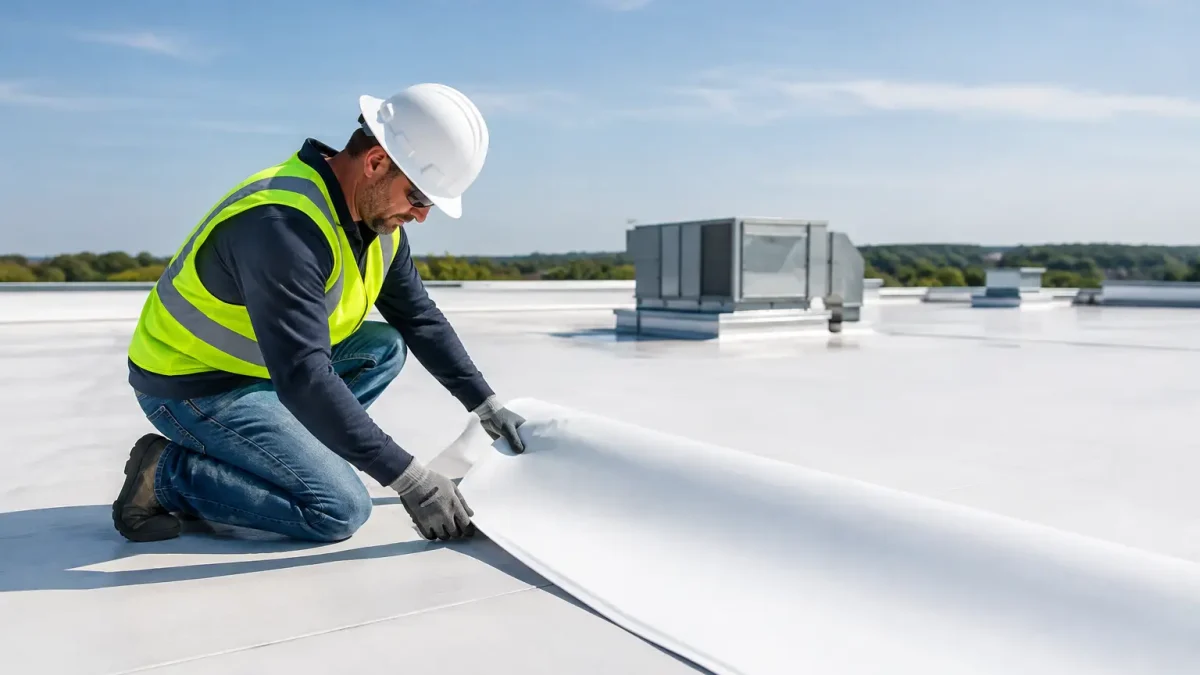
TPO stands for thermoplastic polyolefin. It is a single-ply roofing membrane used primarily on low-slope and flat commercial roofs. The membrane is typically white, though other colors may be available, and it is installed in wide sheets that are heat-welded together at the seams.
Those welded seams are a defining feature. Instead of relying only on adhesive or tape at overlaps, an experienced crew uses hot air to fuse compatible TPO sheets into a continuous assembly. When properly welded and tested, the seams become a strong line of defense against water intrusion.
A complete TPO roof system includes more than the visible membrane. It may also include insulation, a cover board, vapor control layers where needed, fasteners or adhesive, flashings, edge metal, drains, and carefully detailed penetrations around pipes, curbs, and HVAC equipment. A membrane can be high quality and still underperform if any of those components are improperly selected or installed.
Why Building Owners Choose TPO Roofing
TPO is frequently selected because it addresses several practical concerns at once. Its light-colored surface can reflect a meaningful amount of solar heat, which may help reduce heat gain at the roof level. In hot climates such as Arkansas, Oklahoma, and Texas, that can support a more comfortable building and potentially lower cooling demand. Actual energy results depend on insulation levels, HVAC performance, building use, climate, and the rest of the envelope.
The material also resists ultraviolet exposure and is designed to remain flexible through normal temperature changes. That flexibility matters on large roofs, where movement is inevitable. The heat-welded seams offer a durable alternative to systems with more heavily adhesive-dependent lap joints.
For many property owners, TPO offers an attractive value proposition. It is widely available, familiar to commercial roofing professionals, and suitable for a broad range of building types. It can be mechanically attached, fully adhered, or ballasted in limited applications, although attachment methods should be chosen based on wind requirements, deck type, insulation design, and project-specific conditions.
TPO is not automatically the best membrane for every roof. A restaurant with persistent grease exhaust, a facility with unusual chemical exposure, or a roof with demanding service traffic may need a different conversation. PVC, for example, is often considered where grease or chemical resistance is a major concern. The best system is the one designed around the risks your building actually faces.
Where TPO Performs Best
TPO roofing is often a strong fit for broad, low-slope roofs with straightforward drainage and regular rooftop activity. Distribution centers, offices, retail properties, apartments, schools, and light industrial buildings are common applications. It can also work well on re-roofing projects when the existing assembly has been properly evaluated and the new system is designed to meet current code and wind requirements.
A good candidate roof is not simply one with a flat surface. The building should have a drainage plan that moves water efficiently toward properly sized drains, scuppers, or gutters. TPO resists water, but no roofing system benefits from chronic ponding. Long-term standing water can reveal weaknesses in drainage, strain details at seams and flashings, and complicate routine maintenance.
Roof access matters, too. If technicians routinely service HVAC units, solar equipment, communication systems, or other rooftop assets, the system may need designated walk pads and stronger protection at high-traffic routes. A roof is not a maintenance-free platform. Planning for foot traffic before installation is far less costly than repairing damage later.
The Details That Protect a TPO Roof
Most roof leaks do not begin in the middle of an open field of membrane. They develop at transitions: around penetrations, along parapet walls, at expansion joints, near drains, or at roof edges. These details deserve as much attention as the membrane itself.
Seams and Flashings
Heat-welded seams should be consistent, clean, and tested during installation. Flashings must accommodate the shape and movement of pipes, curbs, corners, and walls without creating tension points. Small workmanship issues at these locations can become larger building problems after wind-driven rain or repeated thermal movement.
Insulation and Slope
Insulation does more than support energy performance. A properly designed insulation package can help create positive drainage, reducing the chance that water remains on the roof after a storm. Tapered insulation is often used to direct water toward drains, especially on roofs where existing slopes are insufficient.
Edge Metal and Wind Resistance
Roof edges experience some of the highest wind pressures on the building. Secure edge metal, properly spaced fasteners, and an assembly designed for the local wind zone are essential. This is especially important for exposed commercial properties and facilities in storm-prone regions.
Rooftop Coordination
A new roof can be damaged quickly when other trades install equipment without coordinating with the roofing contractor. Penetrations should be planned, curbs should be flashed correctly, and any later work should be documented. Facility teams benefit from a simple rule: do not allow anyone to cut, fasten through, or modify the roof without roofing review.
What Affects TPO Roof Life?
A TPO roof may provide many years of service, but no responsible contractor should promise a single lifespan without inspecting the building and reviewing the system. Membrane thickness, attachment method, roof traffic, weather exposure, drainage, maintenance, installation quality, and the manufacturer-backed warranty all influence performance.
A thicker membrane may offer greater resistance to punctures and wear in demanding conditions, but thickness alone is not a complete strategy. A thinner membrane installed over the right cover board and protected with walk pads in traffic areas can perform better than a thicker membrane installed with poor detailing or inadequate drainage.
Maintenance also changes the equation. Roof debris can block drains. A loose piece of metal can puncture a membrane in high wind. HVAC service can leave behind dropped screws, sharp tools, or damaged flashings. Periodic professional inspections give property owners an opportunity to correct small issues before interior leaks interrupt operations, damage inventory, or affect occupants.
Repair, Restoration, or Replacement?
When a TPO roof develops a problem, replacement is not always the first answer. A localized puncture, failed flashing, open seam, or damaged drain detail may be repairable if the roof is otherwise dry and in serviceable condition. Fast action matters because water can travel within an assembly and saturate insulation beyond the visible leak point.
If the membrane is aging but still structurally sound, a coating system may be worth evaluating. Coatings are not a universal fix, and they should never be applied over wet materials or unresolved defects. The roof must be cleaned, repaired, and tested for compatibility before a restoration approach is considered.
Replacement becomes more likely when the membrane has widespread deterioration, leaks are recurring across multiple areas, insulation is saturated, or the roof no longer meets the facility’s operational needs. A thorough inspection should identify the source and extent of problems rather than treating every leak as an isolated event.
A Better Way to Plan Your TPO Roof
The most useful roofing decision starts with the building, not a product name. Before specifying TPO, assess the roof deck, existing assembly, drainage, wind exposure, rooftop equipment, foot traffic, interior sensitivity, budget horizon, and warranty requirements. A data center, for example, may require a different risk strategy than a small warehouse, even if both have similar square footage.
For occupied and operationally critical properties, scheduling is part of the roofing plan. Material staging, tear-off areas, odor considerations, weather monitoring, and daily site communication can reduce disruption. Platinum Roofing approaches these projects with the understanding that a roof protects the people, equipment, inventory, and business continuity below it.
If you are seeing ponding water, ceiling stains, loose edge metal, seam concerns, or storm-related damage, arrange an inspection before a minor defect has a chance to become an operational interruption. The right TPO system, installed and maintained with care, can give your building a dependable layer of protection when it needs it most.


 Capstone Marketing