
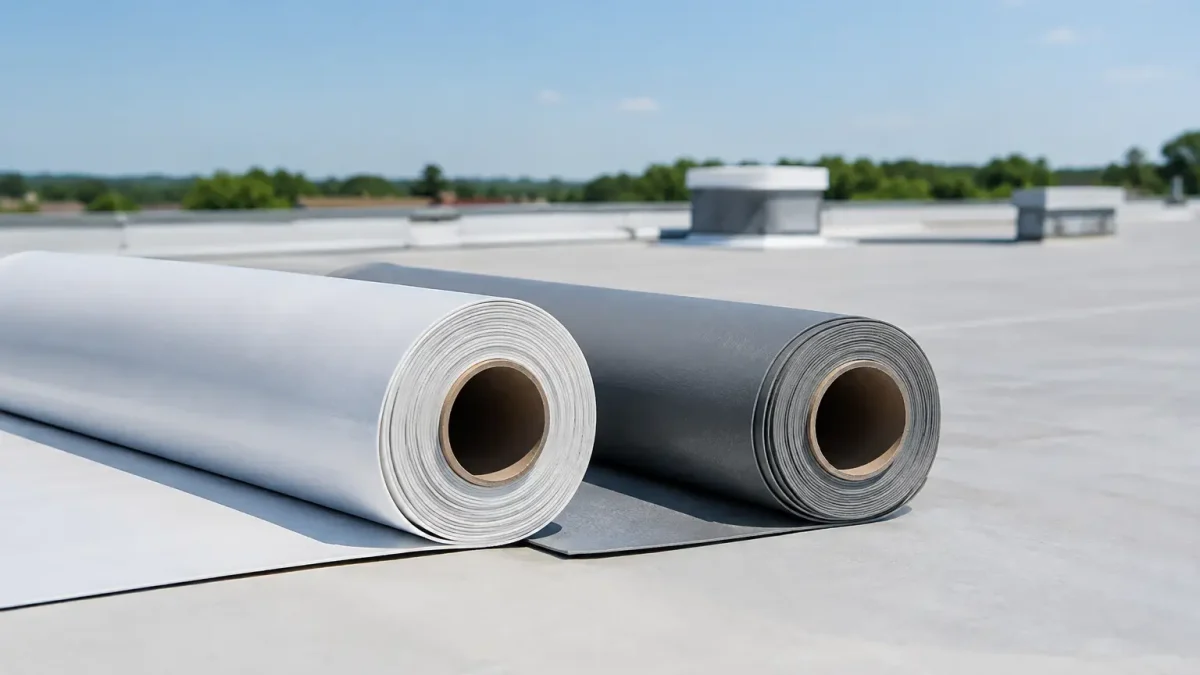
A PVC TPO comparison is not simply a choice between two white roofing membranes. For a facility manager or property owner, the decision affects leak risk, energy performance, maintenance planning, tenant comfort, and the ability to keep operations moving when weather turns severe. Both systems are proven single-ply options for low-slope commercial roofs, but their strengths are not identical.
PVC and TPO can look similar from the ground. Both are commonly white, reflective membranes installed in wide sheets with heat-welded seams. The right choice comes down to what happens on and around the roof: rooftop foot traffic, grease exhaust, chemical exposure, drainage, budget, warranty requirements, and the condition of the existing assembly.
PVC TPO Comparison: The Core Difference
PVC stands for polyvinyl chloride, while TPO stands for thermoplastic polyolefin. Both are thermoplastic membranes, meaning their seams are fused with hot air rather than bonded with adhesive tape. Properly welded seams create a continuous connection that can be highly resistant to water intrusion.
The most meaningful difference is chemical resistance. PVC has a long track record in environments exposed to animal fats, vegetable oils, grease, and many industrial chemicals. That makes it a frequent choice for restaurants, food-processing facilities, commercial kitchens, and buildings with exhaust systems that discharge grease-laden vapors near the roof.
TPO is widely used because it provides strong weather protection, high reflectivity, and competitive value for many commercial properties. It is often an excellent fit for warehouses, offices, retail centers, multifamily buildings, schools, and other facilities without unusual chemical exposure. TPO formulations and manufacturing quality can vary between manufacturers, so the exact product and warranty package deserve close review.
How PVC and TPO Perform on a Commercial Roof
Heat-welded seams and water protection
Both PVC and TPO rely on hot-air welding at laps, penetrations, and flashing details. This is a major advantage over systems that depend entirely on adhesives or asphalt-based seams. A skilled installer can probe and test welds during installation, helping identify incomplete welds before the roof is placed into service.
Still, membrane type alone does not prevent leaks. Many roof failures begin at drains, curbs, pipe penetrations, edge metal, expansion joints, or areas damaged by service trades. The quality of the details, proper drainage design, and regular inspections matter as much as the field membrane.
Resistance to grease and chemicals
PVC generally has the edge where the roof faces grease or chemical contaminants. Restaurant exhaust is the classic example. Grease can collect on a roof surface and may cause premature deterioration in materials not designed for that exposure. PVC is often specified because it performs well in those conditions.
TPO may still be appropriate when exposure is limited or can be managed with properly designed grease containment and scheduled cleaning. The key is to identify the risk before selecting a system. A roof that looks clean during an inspection may still receive regular discharge from nearby fans or vents.
Weathering, heat, and reflectivity
White PVC and white TPO membranes can both reflect a significant amount of sunlight, helping reduce roof-surface temperatures and cooling demand in hot climates. That can be particularly valuable across Arkansas, Oklahoma, and Texas, where summer heat places added stress on roofing systems and HVAC equipment.
Reflectivity should not be the only deciding factor. A highly reflective membrane cannot compensate for wet insulation, poor drainage, damaged flashing, or insufficient attachment. In areas with frequent ponding water, the roofing assembly should be designed to manage the cause of standing water rather than simply cover it.
Puncture resistance and rooftop traffic
Neither membrane is indestructible. HVAC technicians, electricians, solar installers, and other trades can create punctures by dropping tools, dragging equipment, or working without walkway protection. Membrane thickness, reinforcement, cover boards, and designated service paths all influence how well a roof handles traffic.
PVC and TPO are available in different thicknesses, commonly including 45-, 50-, 60-, 80-, and 90-mil options depending on the manufacturer and system. A thicker membrane may offer more material to weather over time, but it does not automatically make a roof better. For heavily trafficked roofs, a cover board and walk pads may provide more practical protection than increasing membrane thickness alone.
Installation Options Matter as Much as the Membrane
PVC and TPO can be mechanically attached, fully adhered, or installed in certain induction-welded assemblies. Each approach has trade-offs.
Mechanically attached systems are often efficient to install and can be a cost-effective option for large roof areas. However, attachment patterns must be engineered for local wind conditions, deck type, building height, and perimeter zones. A roof in an exposed area needs more than a standard fastener pattern.
Fully adhered systems can offer a smoother appearance and may be useful where wind uplift, interior noise, or deck conditions affect the design. They also require suitable substrates and disciplined adhesive application. Moisture, temperature, and surface preparation can influence adhesion.
The best system is the one properly designed for the building, not the one that happens to have the lowest installed price. A complete specification should address insulation, vapor considerations where needed, fastening or adhesive methods, flashing, drains, edge metal, and manufacturer-approved details.
Cost: Look Beyond the Initial Proposal
A TPO roof is often priced more competitively than PVC, which is one reason it is common on broad, straightforward commercial roof areas. PVC may carry a higher material cost, particularly when a premium chemical-resistant system is required.
But the lowest proposal is not always the least expensive roof over its service life. Repeated repairs around grease-contaminated areas, premature membrane deterioration, or disruption caused by leaks can quickly outweigh an initial material savings. For a restaurant, food facility, or industrial property, PVC may be the more economical long-term decision even if it costs more at installation.
Property owners should also compare what each proposal includes. One bid may include a cover board, tapered insulation, upgraded perimeter details, walk pads, and removal of wet materials. Another may not. Comparing only the total price can hide major differences in protection.
When PVC Is Usually the Better Fit
PVC deserves serious consideration when the building has grease exhaust, food-production activity, chemical exposure, or a history of membrane degradation near vents and rooftop equipment. It can also be a strong choice for owners who value its established performance history and want a premium membrane system for a critical facility.
Hospitals, data centers, manufacturing sites, and properties where a leak could interrupt essential operations may also justify a PVC system when the overall design and budget support it. The material is only part of the protection plan, but it can be a valuable part.
When TPO Is Usually the Better Fit
TPO is often a practical choice for large commercial roofs with standard exposure conditions. Warehouses, retail buildings, offices, apartment communities, schools, and many industrial facilities can benefit from a well-specified TPO roof with strong reflectivity and heat-welded seams.
It is especially compelling when the roof requires replacement across a large area and the owner needs reliable performance within a disciplined capital budget. Choosing an established manufacturer, appropriate membrane thickness, and a contractor experienced with the manufacturer’s details is essential.
Do Not Choose by Color or Material Name Alone
A PVC TPO comparison should end with an assessment of the entire roof assembly. Before selecting a membrane, determine whether insulation is wet, whether slopes direct water effectively to drains, whether the deck has limitations, and whether rooftop equipment creates unusual wear or contamination. Infrared moisture scanning, core cuts where appropriate, and a detailed visual inspection can reveal conditions that a surface-only estimate will miss.
Also consider how the roof will be maintained. Semiannual inspections, drain cleaning, seam checks, and prompt repair of accidental damage can extend the useful life of either system. Preventative maintenance is particularly valuable for facilities where a small leak can damage inventory, interrupt production, or create safety concerns.
For commercial property owners, the right roof is not the material with the best reputation in the abstract. It is the system that matches the building’s exposure, operations, budget, and long-term risk. Platinum Roofing approaches that decision with a field-focused inspection and a clear view of what your property needs to stay protected long after installation day.


 Capstone Marketing